
Ideas for better growth
Schema Markup: A Practical Guide for Small Sites
Chris Content · · 5 min read

Which structured data types are worth adding to a small business website, how to implement them safely, and the mistakes that trigger manual actions.
Structured data is a way of telling search engines what a page contains in a format they can parse reliably. It does not make a page rank higher by itself. What it can do is change how the page is presented in results, and give search engines confident facts about your business.
This guide covers which types are worth the effort for a small site, and how to avoid the mistakes that turn structured data into a liability.
The one rule that matters
Mark up only what a visitor can see on the page.
Every structured data guideline reduces to this. Marking up reviews you do not display, FAQs that are not on the page, or prices that differ from the visible price is a policy violation, and it can trigger a manual action that removes rich results across the site.
Use JSON-LD
Three formats exist. Use JSON-LD - a script block in the page - because:
- It is the recommended format
- It is separate from your HTML, so redesigns do not break it
- It is far easier to validate and debug
- It can describe several entities in one block
The types worth adding
Organisation and LocalBusiness
The foundation. It tells search engines who you are:
- Legal name and the name customers use
- Logo, website, and social profiles
- Address, phone, and opening hours for a physical business
- Service area, for businesses that travel to customers
For a business with premises, use the most specific LocalBusiness subtype that fits. Keep it consistent with your Google Business Profile and your visible contact page - see the local SEO checklist.
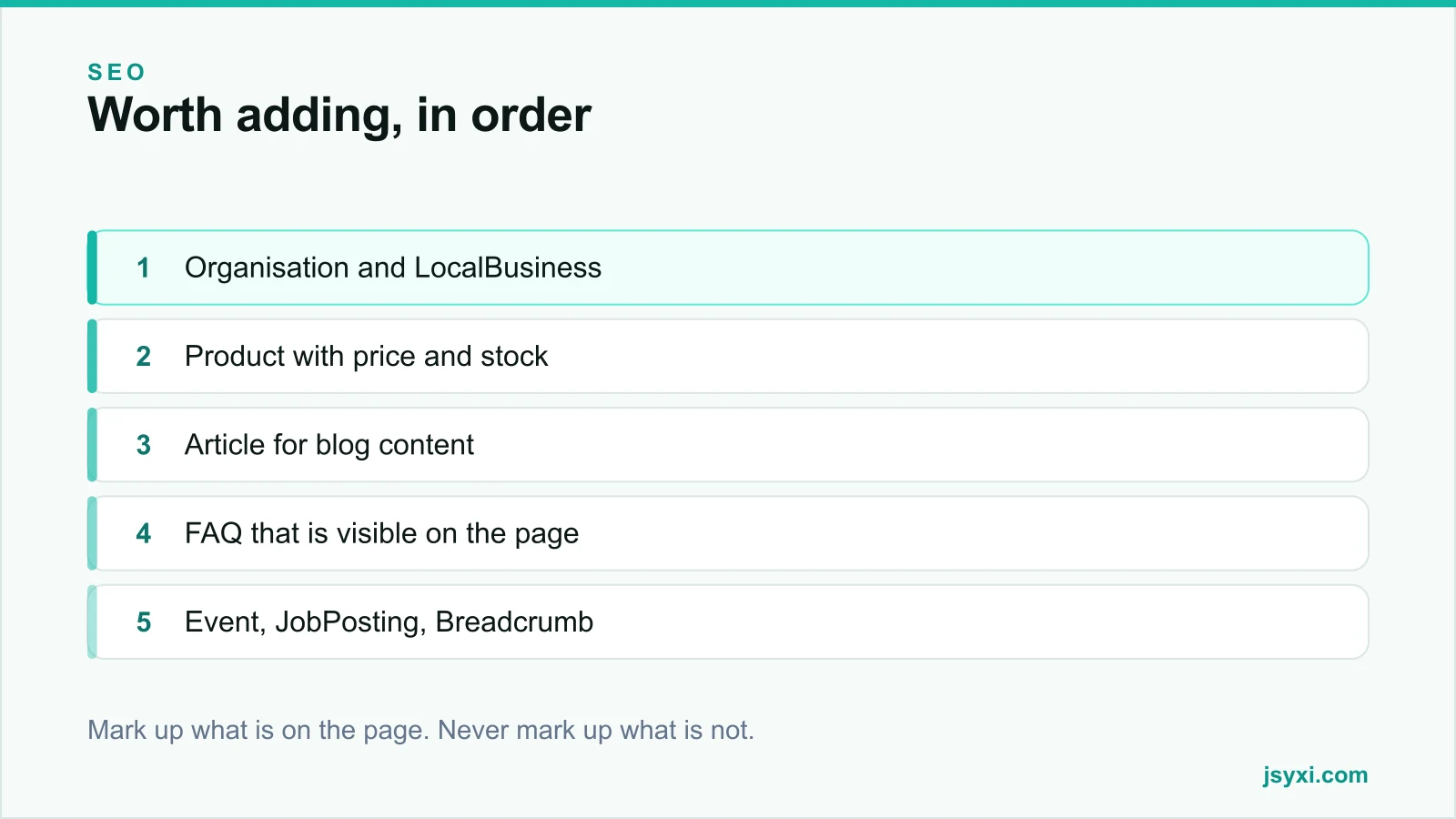
Product
For any page selling a specific item:
- Name, description, image, brand
- Offer with price, currency, and availability
- Condition, if relevant
- Aggregate rating and reviews, only if they are displayed on the page
The price in the markup must match the visible price, including how tax is presented. Stale availability - marking something in stock when it is not - is a common cause of trust problems.
Article
For blog posts and guides:
- Headline, description, and primary image
- Published and modified dates that are accurate
- Author, ideally a person with a real profile page
- Publisher, linked to your Organisation entity
Accurate modified dates matter. Bumping the date without changing the content is a pattern that gets noticed.
FAQPage
For genuine question-and-answer content visible on the page. Use it when:
- The questions and answers are both rendered for every visitor
- The content is genuinely a set of questions, not marketing copy shaped into questions
- The page is not primarily a forum or a support ticket
Note that FAQ rich results are shown selectively and their visibility has changed over time. Add the markup because it describes your page accurately, not because it guarantees a result. Our FAQ accordion guide covers the content side.
BreadcrumbList
Cheap and useful. It helps search engines understand your hierarchy and can improve how the URL line appears in results. Add it wherever you show a breadcrumb trail - and show one on deep pages.
Event and JobPosting
Worth adding if you publish either. Both can produce distinctive listings:
- Event - name, start and end times with timezone, location or virtual location, offers
- JobPosting - title, description, employment type, location, and salary range where you publish one
Keep both current. Expired events and filled roles left marked up are a common source of quality problems. See our event calendar and careers page guides.
What is usually not worth it
- HowTo on pages that are not step-by-step instructions
- Review markup applied to your own business by yourself, which is self-serving and against guidelines
- Speakable, Course, and niche types for a site that does not publish that content
- Anything describing content you plan to add later
Implementation and validation
- Add one type at a time.
- Validate with the Rich Results Test for eligibility and the Schema Markup Validator for syntax.
- Check Search Console's enhancement reports after a week for errors and warnings.
- Fix errors; warnings are usually optional fields worth adding when you have them.
- Re-check after any template change - redesigns break markup silently.
Connect your entities with identifiers so search engines understand they are the same thing: your Article's publisher should point to the same Organisation entity your homepage declares.
Common mistakes to avoid
- Marking up invisible content. The most serious and most common violation.
- Prices that do not match the page. Especially after a sale ends.
- Leaving expired events and filled jobs marked up.
- Multiple conflicting Organisation blocks across templates.
- Assuming markup will lift rankings. It changes presentation, not relevance.
Frequently asked questions
Does schema markup improve rankings?
Not directly. It helps search engines understand your content and can make your result more prominent through rich results, which affects click-through. Relevance and quality still determine ranking.
Which schema types should a small business add first?
Organisation or LocalBusiness on the site, BreadcrumbList on deep pages, Product on commerce pages, and Article on blog posts. Add FAQPage only where a genuine, visible FAQ exists.
Can incorrect schema markup hurt my site?
Yes. Marking up content that is not visible, or prices and ratings that do not match the page, can trigger a manual action that removes rich results for the whole site until it is fixed.
Do I need a developer to add structured data?
Not always. Many platforms emit basic markup automatically. What you do need is someone to validate it and check that it matches what the page actually shows.
Next steps
Validate your homepage and one product page in the Rich Results Test, add Organisation and Breadcrumb markup if they are missing, and check Search Console's enhancement reports a week later.
If you want it implemented and monitored, our digital marketing and SEO service covers structured data as part of a technical audit.