
Ideas for better growth
Local SEO Checklist for Indian Businesses
Chris Content · · 5 min read

Get found in local search: profile completeness, consistent business data, location pages that are not duplicates, reviews, and the signals that move rankings.
Local search is where most small businesses get their highest-intent traffic. Someone searching for a service near them is usually ready to act today.
The work is unglamorous: getting your details right, keeping them consistent, and giving search engines a reason to trust that you exist where you say you do.
1. Claim and complete your business profile
Your Google Business Profile does more for local visibility than your website in many categories. Complete every field:
- Exact business name as it appears on your signage - no keyword stuffing
- Primary category chosen precisely, plus relevant secondary categories
- Full address, or a service area if you travel to customers
- Local phone number, not a national call centre number where a local one exists
- Website URL pointing to the relevant location page, not always the homepage
- Opening hours, plus special hours for holidays
- Attributes that apply - parking, accessibility, payment methods
- Photos of the actual premises, exterior and interior, updated periodically
Our Google Business Profile guide covers the ongoing work in more detail.
2. Make your business details identical everywhere
Name, address, phone. These three must match exactly across:
- Your website's contact page and footer
- Your business profile
- Directories, marketplaces, and aggregators
- Social profiles
- Any listing you paid for
"Shop 4, MG Road" on one and "Shop No. 4, M.G. Road" on another are different strings. Consistency is a trust signal, and inconsistency dilutes it. Pick one canonical format, write it down, and use it everywhere.
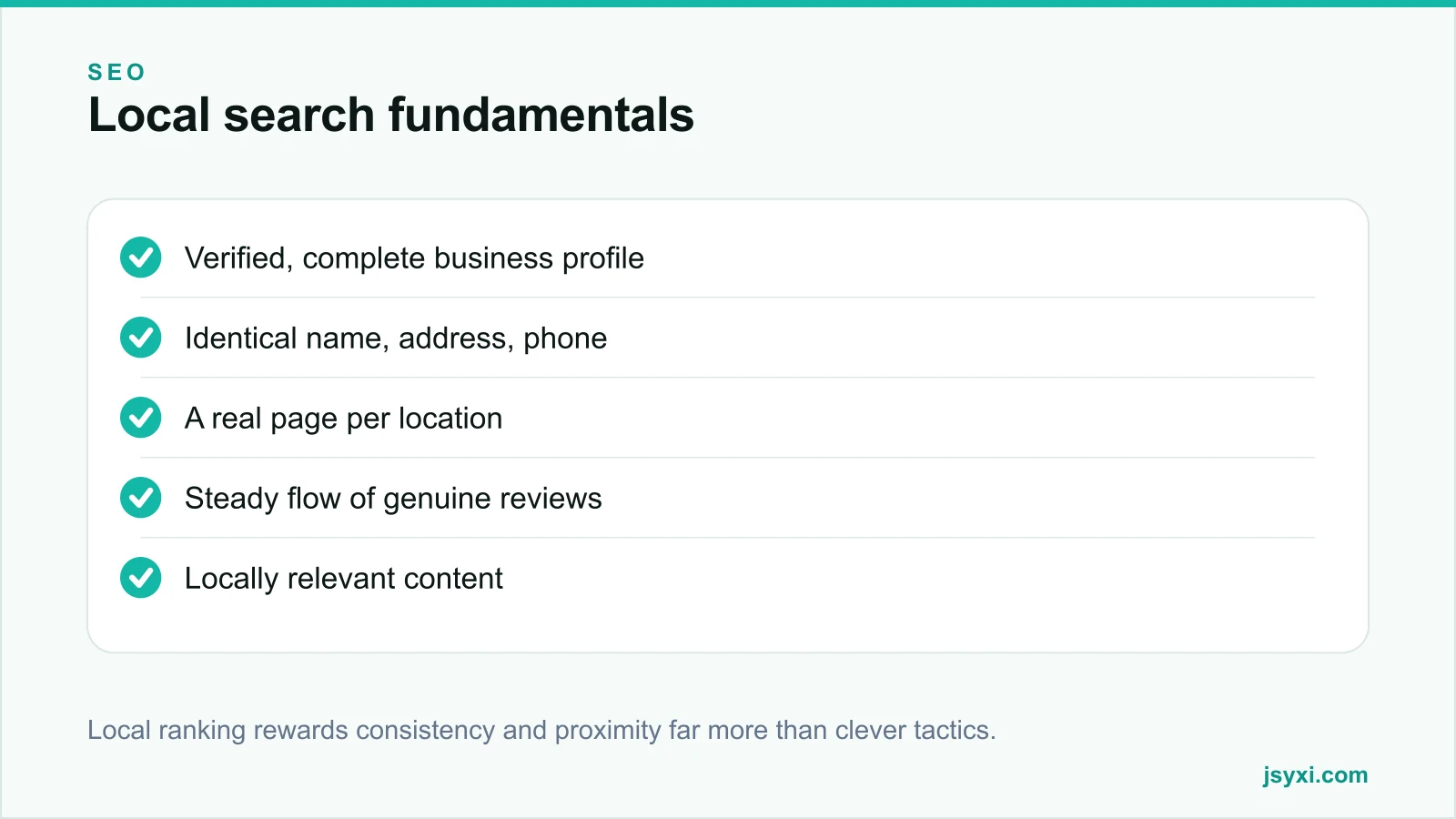
3. Build a real page per location
Multi-location businesses need more than a store list. Each location deserves a page carrying:
- The address as selectable text, with area and PIN code in the heading
- That branch's phone number and hours
- Photos of that specific branch
- Directions and parking guidance, with landmarks
- Services or stock specific to that branch
- Reviews from that location
- Genuinely local content - the neighbourhoods served, nearby landmarks, local delivery notes
Thin pages that differ only by the city name in the template will not rank. If you cannot write two paragraphs of genuinely local content for a branch, you probably do not need a page for it yet.
Use a Store Locator to route visitors to those pages, and see our store locator guide.
4. Earn reviews steadily
Review count, recency, and rating all matter for local visibility, and reviews are also the deciding factor for many customers.
- Ask every satisfied customer, in a consistent way, at the right moment
- Make it one tap - a short link or a QR code at the counter
- Never offer an incentive for a positive review; it violates platform policies
- Respond to every review, positive and negative, briefly and without defensiveness
- Watch for review velocity: a sudden burst looks manipulated
Display genuine reviews on your own site with the Reviews widget as well - see product reviews and social proof.
5. Get the on-page basics right
For each location page and your main service pages:
- Title that includes the service and the place, written naturally
- One H1 that matches
- Address in the page as text, not only in an image or map
- LocalBusiness structured data matching the visible details - see our schema guide
- Internal links from your homepage and services to each location page
6. Publish content that is actually local
Generic service pages compete with everyone. Local content competes with far fewer:
- Service and area pages that name real neighbourhoods you serve
- Projects or case studies with the location stated
- Answers to questions specific to your area - delivery timelines, local regulations, seasonal issues
- Involvement in local events, if genuine
Avoid mass-produced pages naming every locality in the city. They are thin, they compete with each other, and they read as spam.
7. Build citations that matter
A handful of quality listings beats hundreds of low-value ones:
- Major national directories relevant to your industry
- Industry-specific bodies and associations
- Local chamber or trade listings
- Marketplaces where you actually sell
Ensure each carries identical business details and a link where allowed. Then stop - directory spamming has diminishing and sometimes negative returns.
8. Keep everything current
Local data decays. Set a quarterly review of:
- Hours, including upcoming festival closures
- Phone numbers still answered
- Photos still representative
- Services listed still offered
- Any branch that moved or closed
An out-of-date profile causes wasted trips, which cause bad reviews, which cost visibility.
Common mistakes to avoid
- Keyword-stuffed business names. Against platform guidelines and a common cause of suspension.
- A shared national phone number on every branch. Local numbers perform better and get answered faster.
- Duplicate location pages. They compete with each other and rank for nothing.
- Buying reviews. Detectable, against policy, and reputationally fatal when discovered.
- Ignoring negative reviews. A calm, specific response is read by every future customer.
Frequently asked questions
How long does local SEO take to show results?
Profile completeness and consistency can show effects within weeks. Review accumulation and content-driven improvements typically take a few months. Competitive urban categories take longer.
Do I need a separate page for each location?
Yes, if you want each location to rank in its own area, and only if you can give each page genuinely distinct content. A single thin duplicate per city helps nobody.
How important are reviews for local ranking?
Very. Count, recency, rating, and your responses all contribute, and reviews are usually the deciding factor for the customer choosing between two nearby options.
Should my business name include keywords?
No. Use the name on your signage and registration. Adding keywords to the profile name violates guidelines and is a frequent cause of suspension or edits by other users.
Next steps
Audit your business details across every listing you can find and make them identical, then complete every field on your business profile and set a quarterly reminder to review hours and photos.
If you want this run for you, our digital marketing and SEO service covers local search as part of the engagement.