
Ideas for better growth
How to Get More Google Reviews
Chris Content · · 5 min read

Reviews decide local choices. How to ask consistently without breaking platform rules, make leaving one effortless, and respond in a way future customers read.
For a local business, reviews are usually the deciding factor between two options a customer has never used. Count, recency, rating, and your responses all feed into local visibility, and all four are things you influence.
The one thing you must not do is pay for them.
Step 1: Know the rules before you start
Most review platforms prohibit, and can penalise:
- Offering discounts, entries, or gifts in exchange for reviews
- Asking only your happy customers - selective solicitation
- Writing reviews for customers, or asking staff and family to
- Buying reviews from any service
- Setting up a device in-store that filters out negative feedback before it reaches the platform
These are detectable, and the consequences range from removed reviews to a suspended profile. They also fail on their own terms: a wall of implausible five-star reviews reads as fake.
Ask everyone, ask honestly, and accept what you get.
Step 2: Choose the moment
Ask when the value is fresh and obvious:
- Immediately after a service is completed and the customer is visibly happy
- At handover or collection
- A few days after delivery, once the product has been used
- After a support issue is resolved well - these often produce the most persuasive reviews
- At a renewal or repeat purchase
Do not ask while an issue is open, and never ask twice.
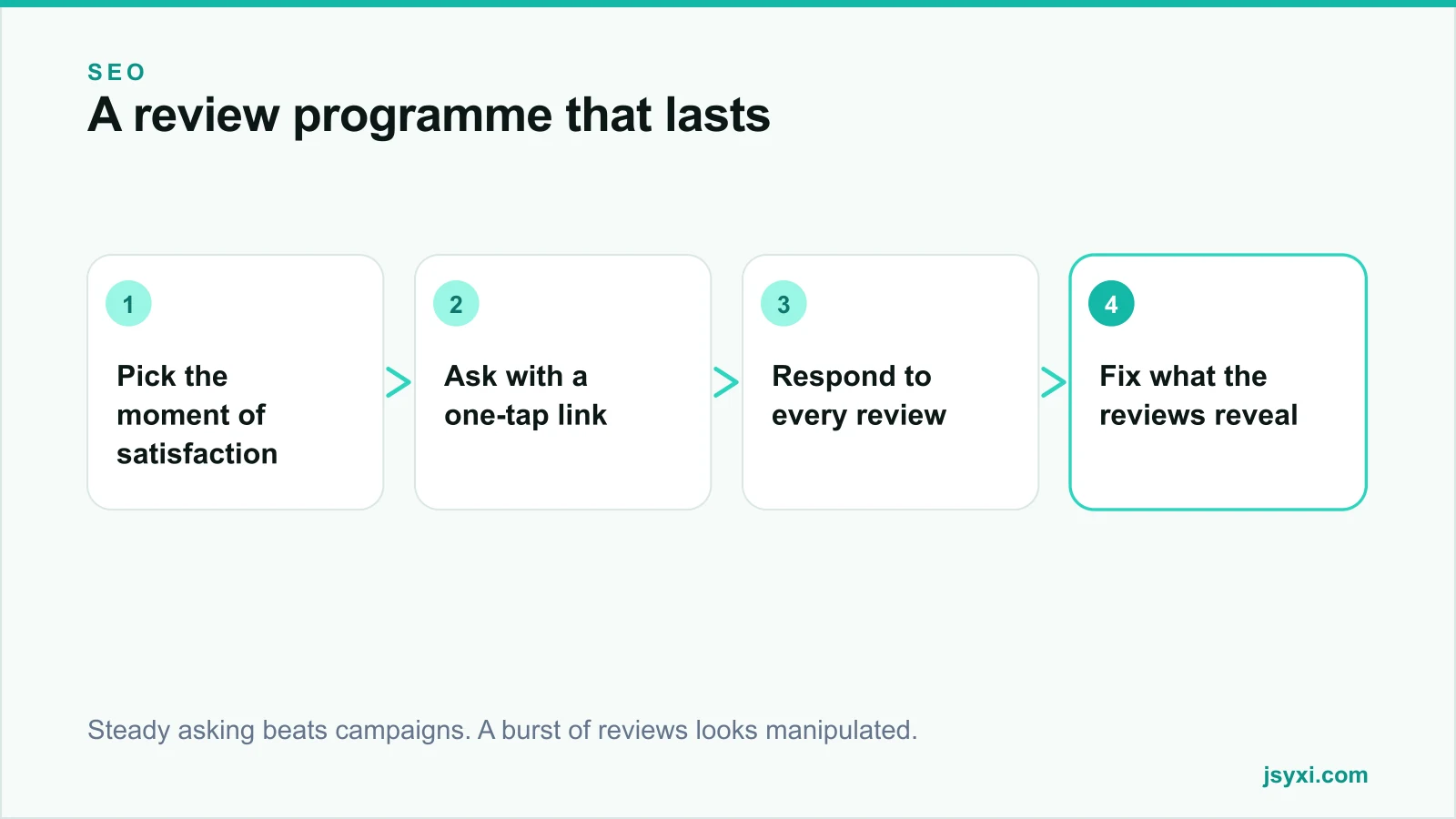
Step 3: Make it one tap
Every extra step loses a large share of willing reviewers:
- Use your profile's short review link, not "search for us and scroll down"
- Put a QR code at the counter, on the invoice, and on the delivery note
- Send the link by the channel the customer already uses - WhatsApp or SMS beat email in many markets
- On mobile, the link should open the review form directly
Test the whole journey on a phone that is not signed into your own account.
Step 4: Ask like a person
- Keep it to two sentences
- Say why it helps: it helps other people find you
- Do not script the content or suggest what to write
- Do not mention stars or ask for a "5-star review" - that is soliciting a rating, not a review
- Make it clear it is optional
"If you have a minute, a short Google review really helps other people find us. Here's the link." is enough.
Step 5: Respond to every review
Responses are read by future customers far more than by the reviewer:
- Reply within a few days
- Keep it short and specific - reference what they actually mentioned
- Thank positive reviewers without gushing
- For negative reviews: acknowledge the specific issue, say what you are doing, and offer to continue privately
- Never argue, never blame the customer, and never disclose their details
- Do not use identical copy-pasted replies on every review
A calm, specific response to a critical review persuades more readers than several five-star ratings.
Step 6: Use what reviews tell you
Reviews are free product and operations research:
- Group them by theme - delivery, quality, staff, value, communication
- Track themes over time; a new complaint appearing repeatedly is a process change gone wrong
- Feed positive phrasing back into your product pages
- Feed recurring questions into your FAQ accordion
Step 7: Show reviews on your own site too
Your profile serves search; your website serves the visitor already there:
- Display genuine reviews with the Reviews widget
- Show the count and the average, not just the average
- Place reviews beside the claims they support - see social proof types and placement
- Never edit a review's meaning, and never publish one you did not receive
Our guide to collecting and placing product reviews covers the on-site side, and local SEO covers how reviews feed local ranking.
Step 8: Make it a habit, not a campaign
A sudden burst of reviews looks manipulated and can be filtered:
- Build the ask into the normal end of a transaction
- Give staff a simple, consistent script and the QR code
- Track how many are asked versus how many are received
- Aim for a steady trickle rather than monthly pushes
Common mistakes to avoid
- Incentivising reviews. Against policy, detectable, and it corrupts the signal.
- Asking only happy customers. Selective solicitation is prohibited on most platforms.
- A review link that requires searching. Most people give up.
- Ignoring negative reviews. Silence is read as indifference.
- Identical replies on every review. It signals nobody is actually reading them.
Frequently asked questions
How do I ask customers for a Google review?
At the moment of satisfaction, with a short personal message and a one-tap review link or QR code. Do not script the content, do not ask for a specific rating, and do not offer anything in return.
Can I offer a discount for a review?
No. Incentivising reviews violates the policies of most major platforms, can lead to removed reviews or profile suspension, and undermines the credibility of every review you have.
Should I respond to negative reviews?
Always. Acknowledge the specific problem, say what you are doing about it, and offer to continue privately. Future customers judge you on the response far more than on the complaint.
How many reviews do I need?
Enough that the average is stable and recent - the trend matters more than a target. Steady, ongoing reviews signal an active business; a sudden burst looks manipulated.
Next steps
Create your short review link, print a QR code for the counter and the delivery note, and add the ask to the end of your normal handover script. Then reply to every review you already have.
Start free and show the genuine ones on your site with the Reviews widget.