
Ideas for better growth
Social Proof: Which Type Belongs Where
Chris Content · · 4 min read
Reviews, ratings, logos, counters, case studies and testimonials each answer a different doubt. A map of which proof to use at which point in the journey.
Social proof is usually treated as a single ingredient: add testimonials, add logos, done. In practice each type of proof answers a different question, and proof placed away from its question does nothing.
This guide maps the types of proof to the moments where they work.
The four doubts, in order
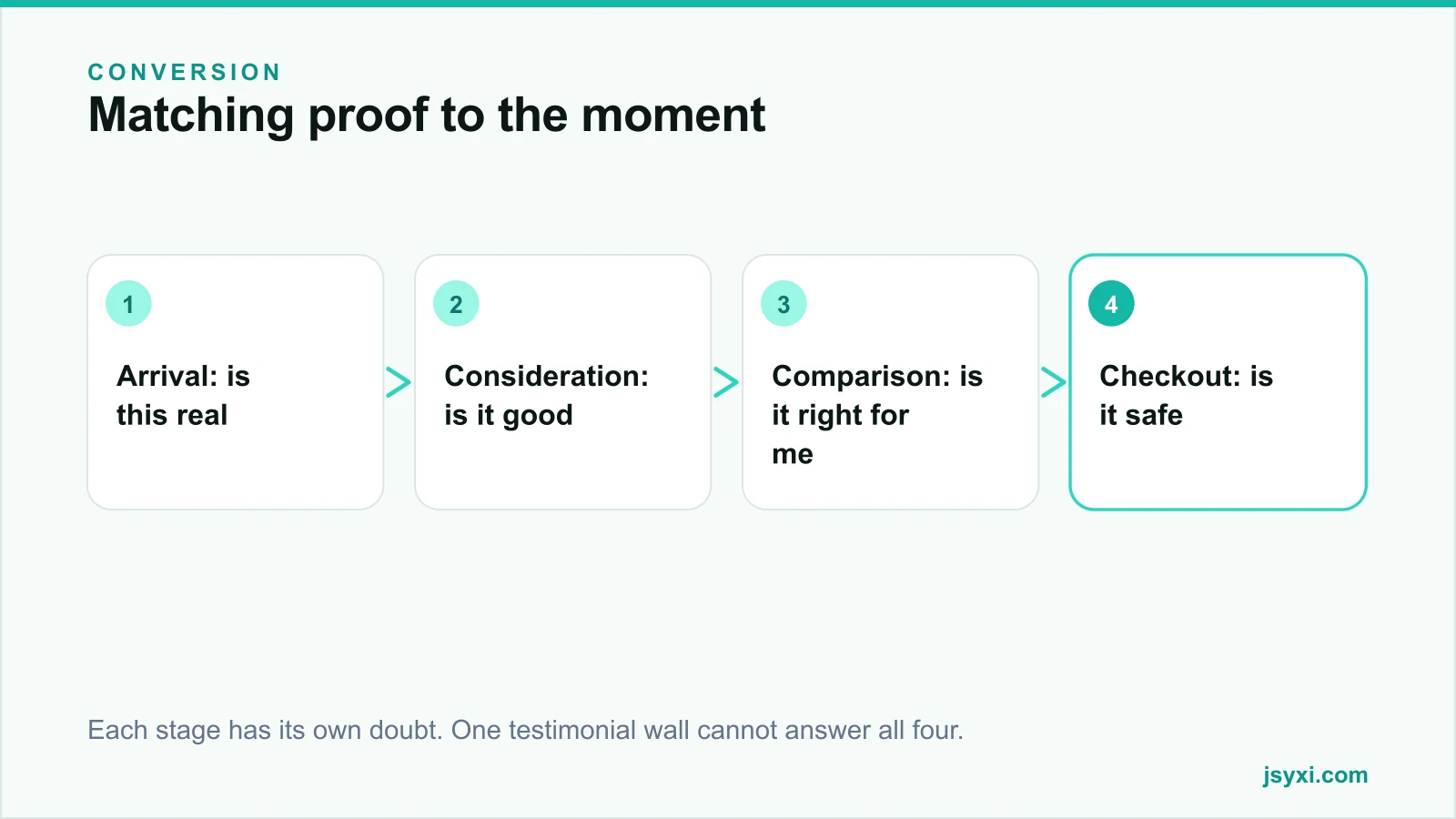
A visitor moves through four doubts:
- Is this business real? - on arrival
- Is the product any good? - during consideration
- Is it right for someone like me? - during comparison
- Is it safe to pay? - at checkout
Every piece of proof you own answers one of these. Placing it against the wrong doubt wastes it.
Doubt 1: Is this business real?
Answered by presence and specificity, not by praise.
- A real address and phone number, visible - see business hours and maps
- A named team with faces, through a Team Showcase
- Recognisable client or partner logos, with permission
- A verified rating from an external platform, with the real count
- Activity: recent posts, recent reviews, recent orders
One named client is worth more than twelve anonymous grey logos. A Logo Showcase works here, on the homepage and about page.
Doubt 2: Is the product any good?
Answered by volume and average.
- Star rating with the review count, near the product title
- Review distribution, so the buyer can see the shape, not just the mean
- Photos submitted by customers
- Verified-purchase markers where you can support them
Show the count honestly. "4.6 from 218 reviews" is credible; "4.9" alone is not. A Rating summary near the title plus the full reviews below covers both scanning and reading.
Doubt 3: Is it right for someone like me?
This is where most stores lose people, and where generic proof is useless. The buyer wants evidence from someone with their problem.
- Reviews filterable by attributes that matter - size bought, skin type, room size, use case
- Testimonials that state the starting problem, not just the outcome
- Case studies with named context: industry, size, constraint
- Before and after comparisons with the scope stated - see the Before / After widget
- Q&A where previous buyers answer new buyers
A single specific review from a customer with the same constraint outperforms fifty generic five-star ratings.
Doubt 4: Is it safe to pay?
Answered by risk reversal and support presence.
- Return policy stated in one line at the payment step
- A visible support route - phone or WhatsApp
- Payment security indicators that are genuine
- Delivery date restated, so nothing is a surprise
- Order confirmation that arrives immediately
See trust signals for online stores for what belongs here and what is decoration.
Types of proof and what each is actually for
- Star ratings - fast quality signal. Needs a real count beside it.
- Written reviews - detail and objection handling. Needs filtering to be useful.
- Customer photos - realism. Powerful for anything visual or physical.
- Testimonials - narrative proof for services. Needs full attribution.
- Case studies - depth for high-consideration purchases.
- Client logos - credibility by association. Only with permission and only if recognisable.
- Counters - "12,000 orders shipped" works if it is true and current. See the Stats Counter.
- Live activity - "3 people viewing this" is only acceptable if it reflects real data. Fabricated activity is a consumer protection risk and is usually spotted.
- Awards and certifications - useful when recent and relevant; harmful when years old.
Rules that apply to all of them
- Never fabricate. Invented reviews, fake counters, and stock-photo faces are detectable and, in many markets, unlawful.
- Show dates. Undated proof reads as old proof.
- Include the count. An average without a denominator means nothing.
- Do not hide negatives. A visible three-star review with a good response builds more trust than a wall of fives.
- Keep it current. Retire proof that no longer reflects the business.
Common mistakes to avoid
- One testimonial wall on the homepage. It answers doubt 1 slightly and nothing else.
- Reviews only at the very bottom of the product page. The doubt arises much earlier.
- Logos with no permission or no relevance.
- A five-star average from six reviews presented as authority.
- Live-visitor counters that are simulated. Treat this as a line you do not cross.
Frequently asked questions
How many reviews do I need before showing a rating?
Enough that the average is not distorted by a handful of opinions - usually around twenty for a product. Below that, show the individual reviews without a headline average.
Should I show negative reviews?
Yes. A visible mix with thoughtful responses is more persuasive than uniform praise, and buyers actively look for the critical reviews to judge whether the flaws matter to them.
Where do client logos work best?
On the homepage and about page, answering "is this business real". They do almost nothing on a product page, where the buyer wants evidence about the product.
Are live visitor counters a good idea?
Only if the number is real. A genuine visitor counter backed by your own analytics is honest; a simulated one is a fabricated claim and is usually recognised as one.
Next steps
Write down the four doubts, list the proof you already own, and map each piece to the doubt it answers. Move anything that is in the wrong place, and identify which doubt you currently have no evidence for.
Start free and put your proof where the hesitation actually happens.