
Ideas for better growth
A Return Policy That Builds Trust
Chris Content · · 4 min read

A clear return policy sells more than it costs. How to write one customers understand, where to show it, and how to reduce returns without hiding the terms.
A return policy is read before the purchase far more often than after it. For a first-time buyer, it is the answer to the last question standing between them and the pay button: what happens if this is wrong?
Written well, it removes that hesitation. Written as legal boilerplate and buried in the footer, it creates it.
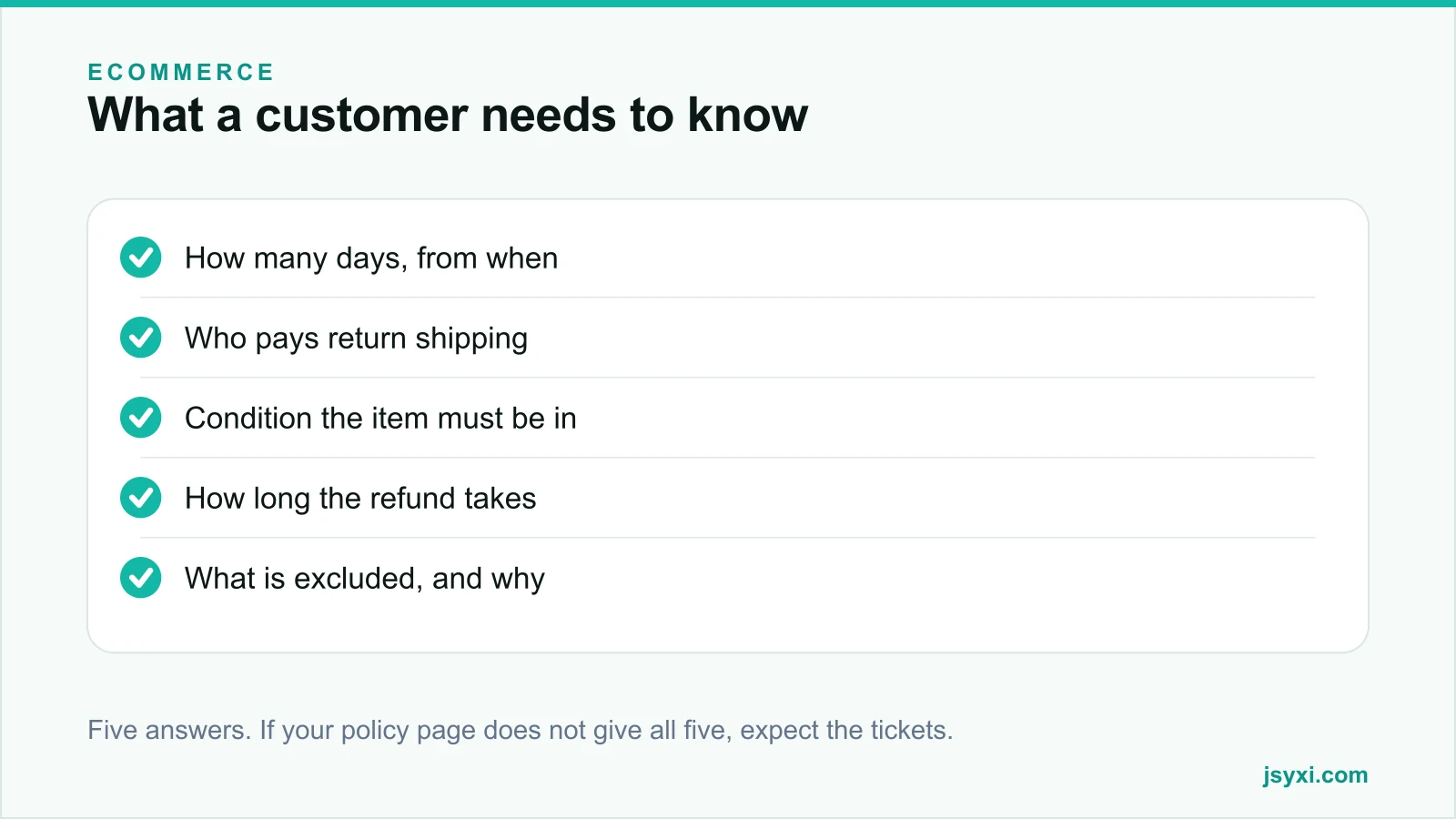
The five things a customer needs
Every policy must answer these plainly, near the top:
- How long they have, and from which date - delivery, not order
- Who pays return shipping, for a change of mind and for a fault
- What condition the item must be in - unused, tags attached, original packaging
- How long the refund takes, and to which method it returns
- What is excluded, and the reason
If a customer cannot answer all five in thirty seconds, your support inbox will supply the difference.
Write it in plain language
Legal accuracy and plain language are not in conflict. Write the customer-facing version first:
- Short sentences, ordinary words
- Second person: "You have 7 days from delivery"
- Numbers as numerals
- One idea per paragraph
- A summary box at the top, with the detail below
Keep any formal terms your lawyer requires further down the page, under a clear heading. The summary is what gets read.
Be honest about exclusions
Exclusions are legitimate. Hiding them is not.
- Hygiene and personal-care items
- Custom or personalised goods
- Perishables
- Software or digital goods once accessed
- Clearance items, if genuinely excluded
State each exclusion with a one-line reason. "Earrings cannot be returned for hygiene reasons" is accepted; discovering it at the return request is not.
Also check the consumer protection rules in your market. Statutory rights for faulty goods generally sit above your policy, and a policy implying otherwise creates legal exposure as well as bad will.
Show it where the doubt happens
The policy page is not where the question is asked. Put the answer next to the decision:
- On the product page, one line above the add-to-cart button: "7-day returns. We pay return shipping on faults."
- In the cart, as a short reassurance line
- At checkout, near the pay button - see our cart abandonment guide
- In the order confirmation, so the customer has it on record
- **In a FAQ accordion** on the product page
Our post on trust signals covers the wider set of reassurances that belong at the final step.
Make the process easy to start
A policy is only as good as the process behind it:
- One obvious route to start a return - a form, a link in the order email, or a chat handoff
- No requirement to phone during working hours only
- A clear list of what you need from the customer
- An acknowledgement within one working day
- Status updates as it progresses
- Refunds processed on the day the item is received and checked, not the end of the month
The most-cited complaint is not the policy terms. It is silence after the return was posted.
Reduce returns at the source
The right way to lower return rates is to prevent the mismatch, not to make returns harder:
- Accurate dimensions and honest fit guidance - see writing product descriptions
- Images that show scale, texture, and true colour
- A size guide that matches the actual garment
- Explicit compatibility lists
- Customer photos in reviews
- A WhatsApp route so pre-purchase doubts get answered before the order
Track your top return reasons monthly. Each one points at a specific line missing from a specific page.
Consider what a longer window does
A generous window feels expensive and often is not:
- It removes hesitation at the point of purchase
- Return rates do not usually rise in proportion to window length
- Longer windows can reduce impulsive returns, because the pressure to decide immediately is gone
Test it if you can measure it. If you cannot, at least make sure the window you offer is stated everywhere identically.
Common mistakes to avoid
- Policy only in the footer. The question is asked on the product page.
- Legal language nobody parses. Write the plain summary first.
- Silent exclusions. They become disputes and chargebacks.
- A returns process that requires a phone call. It reads as deliberate friction.
- Different terms on different pages. Publish once, reference everywhere.
Frequently asked questions
How long should a return window be?
Long enough to remove hesitation - commonly 7 to 30 days from delivery depending on category. What matters more than the number is that it is stated consistently everywhere and honoured without argument.
Should I offer free returns?
Free returns on faults are expected and often required. For change-of-mind returns, decide based on margin and category, and state the position clearly on the product page rather than at the return request.
Where should the return policy appear?
Summarised on the product page above the add-to-cart action, repeated at checkout, included in the order confirmation, and in full on its own page. The footer link alone is not enough.
How do I reduce returns without making them harder?
Fix the mismatch: accurate dimensions, honest fit guidance, true-colour images, compatibility lists, customer photos, and a pre-purchase question route. Track return reasons monthly and fix the page that caused each one.
Next steps
Rewrite your policy as five plain answers, put a one-line summary above the add-to-cart button on your best-selling product, and check your last twenty return reasons for the pages that caused them.
Start free and publish the summary as a FAQ accordion where buyers actually look.