
Ideas for better growth
How to Write Product Descriptions That Sell
Chris Content · · 4 min read

Descriptions that answer real questions instead of listing adjectives: structure, specifications, objection handling, and writing for both buyers and search.
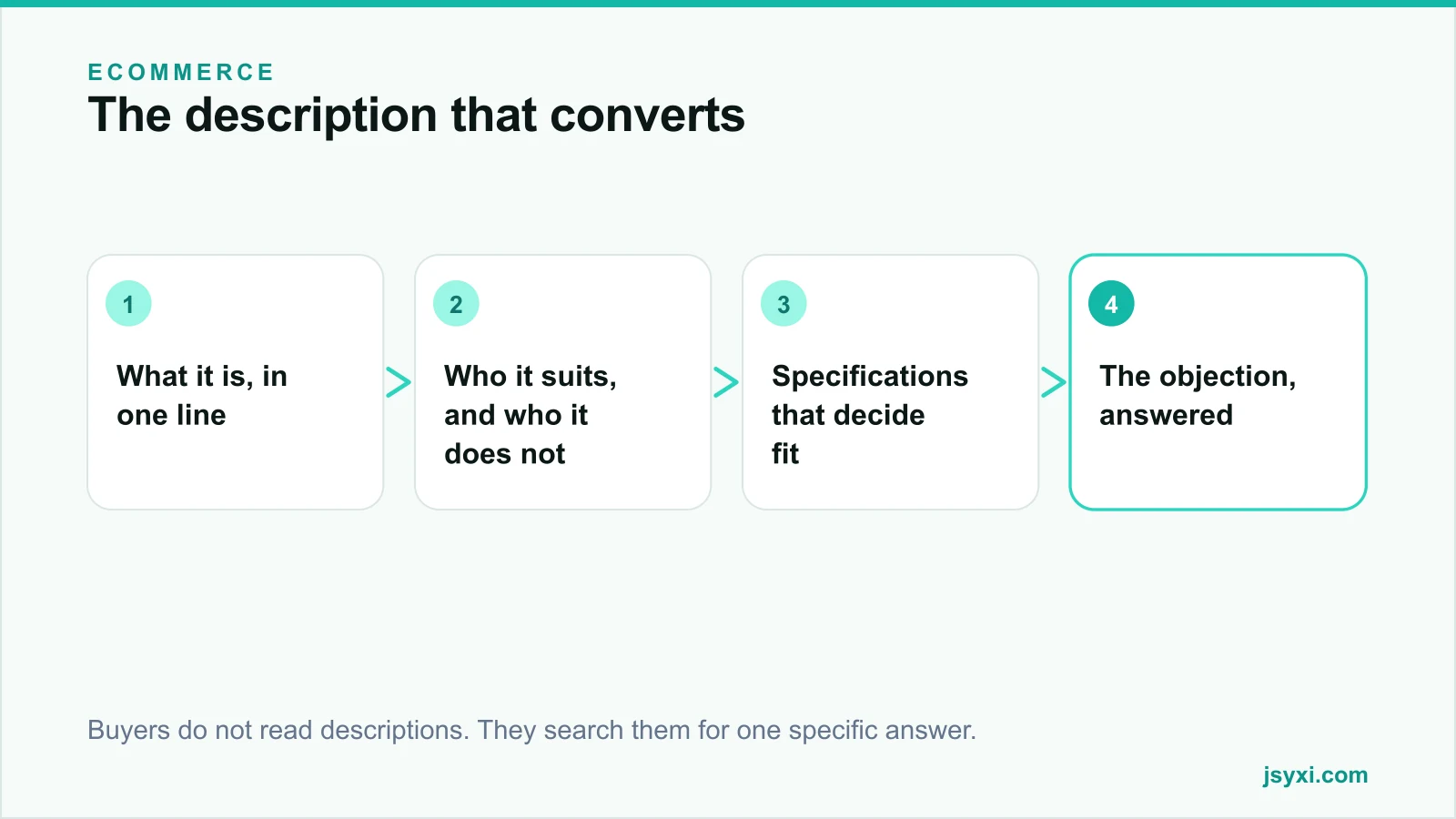
Most product descriptions are written as if the buyer will read them start to finish. They will not. They scan for the one fact that resolves their doubt - will it fit, will it last, will it work with what I already have - and if they cannot find it in a few seconds, they leave or they message support.
Write for scanning, and write for the doubt.
Step 1: Find out what the doubt actually is
You already have the data:
- Pre-purchase questions in support, chat, and WhatsApp
- Return reasons, which are unanswered questions with a refund attached
- Review text where buyers explain what surprised them
- Site search terms on that product
- Questions your sales staff answer in the shop
Each recurring question is a line the description is missing. Fix the top three before touching the prose.
Step 2: Open with what it is, plainly
The first line should let someone who arrived from search confirm they are in the right place:
- What the product is, in ordinary words
- The defining attribute - material, size, capacity, compatibility
- Who it is for
"A 1.2-litre borosilicate glass teapot with a stainless steel infuser, for loose-leaf tea." No adjectives required. A buyer now knows whether to keep reading.
Step 3: Say who it is not for
Counter-intuitive and one of the highest-return lines you can write:
- "Not suitable for induction hobs"
- "Runs small - size up if you are between sizes"
- "Designed for indoor use only"
Every buyer you turn away here is a return you do not process, a support ticket you do not answer, and a one-star review you do not receive. Honesty about limits also makes the positive claims more believable.
Step 4: Give specifications that decide the purchase
Bullet the facts a buyer needs to compare:
- Dimensions and weight, in the units your market uses
- Materials and finish
- Capacity, output, or coverage
- Compatibility and requirements
- Care instructions
- What is in the box
- Warranty period
Put these in a scannable list, not a paragraph. If a specification varies by variant, make sure it updates when the variant changes - a common and expensive product page bug covered in our product page checklist.
Step 5: Translate features into consequences
A feature is a fact; a benefit is what it means:
- "Borosilicate glass" → "handles boiling water without cracking, and goes in the dishwasher"
- "1,200 mAh battery" → "about two weeks of typical use between charges"
- "GSM 280 cotton" → "heavy enough to hold its shape after repeated washing"
Keep the feature next to the consequence. Buyers who know the category want the number; buyers who do not want the meaning.
Step 6: Handle the last objections on the page
Before the add-to-cart action, close the remaining doubts:
- Delivery cost and estimated date
- Return window and who pays return shipping
- Whether it is genuine, and the warranty route
- A size guide or compatibility list
A short FAQ accordion with the five real objections outperforms three more paragraphs of description. Add a WhatsApp route for the compatibility questions no page can anticipate.
Step 7: Write for search without writing for robots
- Use the words buyers search with - including the everyday name, not only your internal one
- Put the important attributes in the title and the first line
- Cover the variations naturally rather than repeating a phrase
- Write a unique description per product; duplicated manufacturer copy competes with every other seller using it
See our keyword research guide for how to find the phrasing customers actually use.
Step 8: Format for scanning
- Short paragraphs, two or three sentences
- Bulleted specifications
- Subheadings for description, specifications, care, and delivery
- Bold only the words that carry a decision
- No wall of text, and no essential fact hidden behind a collapsed tab nobody opens
Common mistakes to avoid
- Manufacturer copy pasted in. It is duplicated across every competitor.
- Adjectives instead of facts. "Premium quality" tells a buyer nothing.
- No dimensions. The most common cause of size-related returns.
- Specifications that do not update with the variant.
- Never revisiting. Return reasons are free instructions for improving the page.
Frequently asked questions
How long should a product description be?
Long enough to answer every real objection and no longer. A simple accessory may need 80 words; a technical product may need 400. Coverage matters, not length.
Should I use the manufacturer's product description?
No, or not alone. It is duplicated across every retailer selling the item, so it neither differentiates you nor helps you rank. Rewrite it around the questions your own buyers ask.
What information reduces returns most?
Accurate dimensions, honest fit guidance, clear material and compatibility details, and an explicit statement of who the product is not for.
Where do I find out what to write about?
Support and chat questions, return reasons, review text, and site search terms on that product. Every recurring question is a missing line.
Next steps
Take your highest-return product, list the last twenty return reasons and support questions, and rewrite the description so every one of them is answered above the add-to-cart button.
Start free and add a FAQ accordion with the five objections that remain.