
Ideas for better growth
How to Add a Company Timeline to Your Website
Chris Content · · 4 min read

A timeline turns years in business into visible credibility. Which milestones to include, how to write entries, and how to keep it from becoming a graveyard.
A timeline is one of the few ways to make longevity visible. For a business that has been operating for a decade, it converts an abstract claim - "established 2016" - into a sequence a visitor can scan and believe.
It also fails in a predictable way: as a list of internal announcements nobody outside the company cares about.
What belongs on a timeline
Include entries that changed what a customer can expect from you:
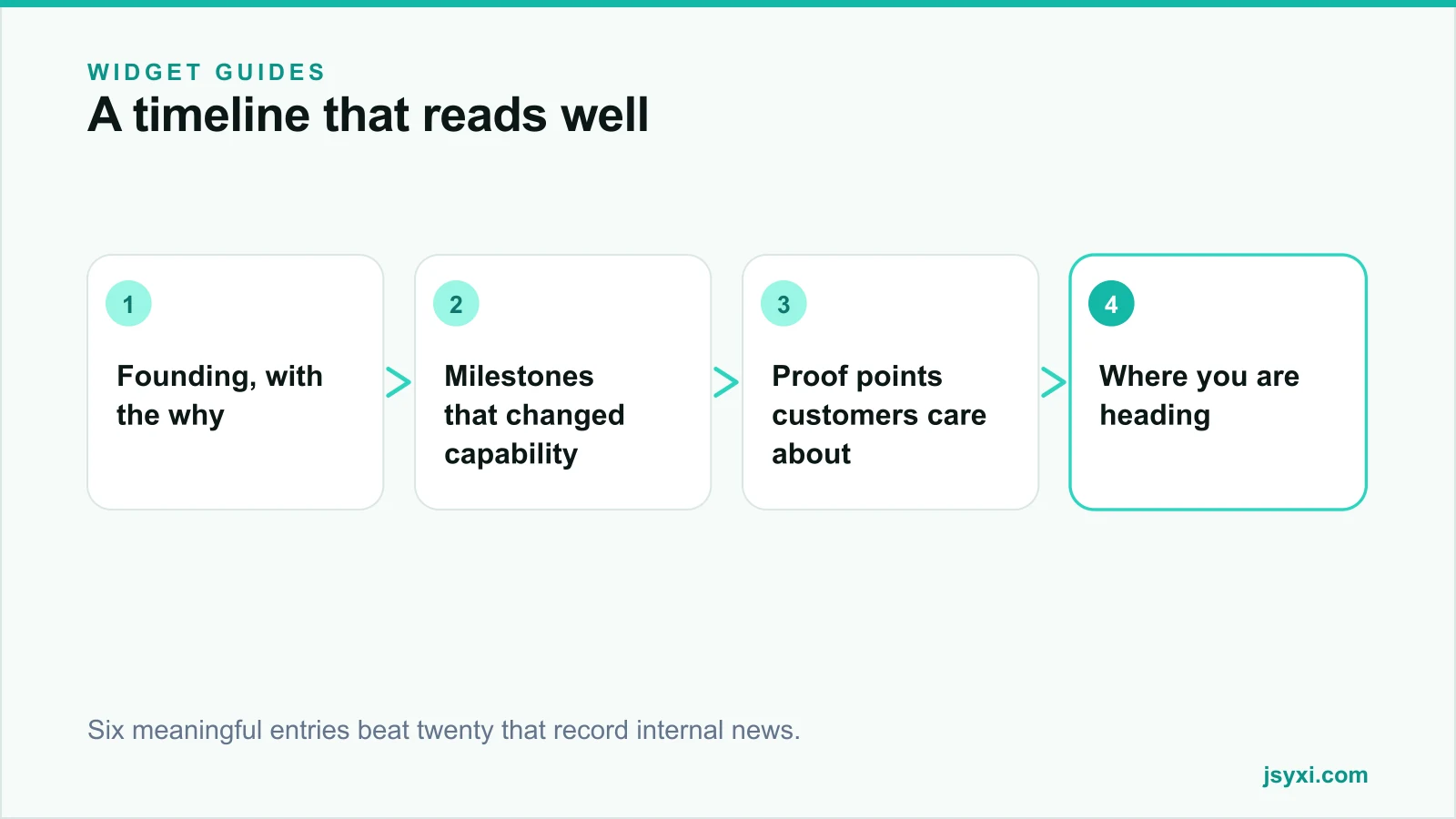
- Founding, with a one-line reason it started
- Capability milestones - a second location, a new production line, a service you added
- Scale milestones - the thousandth order, the first export, the first enterprise client
- Credibility milestones - a certification, a registration, a recognised client
- Team milestones, where the person matters to customers
- Where you are heading, as the last entry
Leave out office moves nobody noticed, internal reorganisations, minor awards, and anniversaries of things already on the list.
How to write each entry
- Date - year is usually enough; add the month only if it matters
- A short title - five or six words
- One or two sentences explaining why it mattered to customers
- A number where you have one, and can source it
Write in plain past tense. "Opened a second workshop in Pune, cutting delivery times for western India to two days" is a milestone. "Embarked on an exciting new chapter" is not.
How many entries
Six to twelve for most businesses. A timeline is a scan, not an archive.
If you have been operating for twenty years, group the quiet periods: one entry can cover several years of steady growth. Long runs of thin entries make the busy years look less significant.
Build it without editing your theme
The Timeline widget presents milestones as an animated vertical sequence and embeds with one line.
Configure:
- Chronological order, oldest first, so it reads as a story
- Consistent date formatting throughout
- Optional image per entry, kept small and consistent
- Animation that respects reduced-motion preferences
Place it with the embed snippet guide.
Where it belongs
- About page, as the spine of the story
- Careers page, showing candidates a business with direction - see our careers page guide
- Investor or partner pages
- A service page, when the timeline is specific to that capability
It does not belong on a product page or anywhere a visitor is trying to buy something.
Pair it with a team page and, where you have the numbers, an animated counter row.
Keep it alive
The failure mode of a timeline is obvious to every visitor: the last entry is four years old.
- Add an entry whenever something genuinely changes
- Review annually, at minimum
- If nothing has happened in two years, either find the milestone you overlooked or remove the timeline
- Keep the forward-looking entry current, or drop it rather than leaving a stale ambition
Make it accessible
- The sequence must read correctly in source order for screen readers, not only visually
- Do not rely on colour or position alone to convey chronology
- Ensure any scroll-triggered animation degrades to static content
- Keep date text as text, never inside an image
See our accessibility checklist.
Common mistakes to avoid
- Internal news nobody cares about. Office moves and reorganisations are not milestones.
- A stale final entry. It dates the whole site.
- Twenty entries. It becomes an archive nobody scans.
- Vague copy. "A new chapter" says nothing; a number and an outcome say plenty.
- Dates inside images. Unreadable and unsearchable.
Frequently asked questions
What should go on a company timeline?
Milestones that changed what customers can expect: founding, new locations or capabilities, meaningful scale numbers, certifications, and recognisable clients. Leave internal news off.
How many milestones should a timeline have?
Six to twelve. Group quiet periods into a single entry rather than padding the list with thin ones.
Where should a timeline go on a website?
The about page, and the careers page where you want candidates to see direction. It has no place on product or checkout pages.
What if we have not had a milestone in years?
Either you have overlooked one - a capability, a client, a certification - or the timeline is the wrong tool right now. A timeline ending four years ago is worse than none.
Next steps
Write down the six moments that actually changed what you can do for customers, add a number to each where you have one, and publish them with the Timeline widget on your about page.
Start free and make your history work for you.