
Ideas for better growth
A B2B Website Lead Generation Playbook
Chris Content · · 4 min read
B2B buyers research quietly and decide as a group. How to structure a site for long cycles, multiple stakeholders, and enquiries that sales actually wants.
B2B websites are usually built like consumer sites with longer forms. That mismatch explains most of their poor performance: the buyer is a group, the cycle is months long, and most of the research happens before anyone identifies themselves.
This playbook covers what a B2B site actually has to do.
Understand who is reading
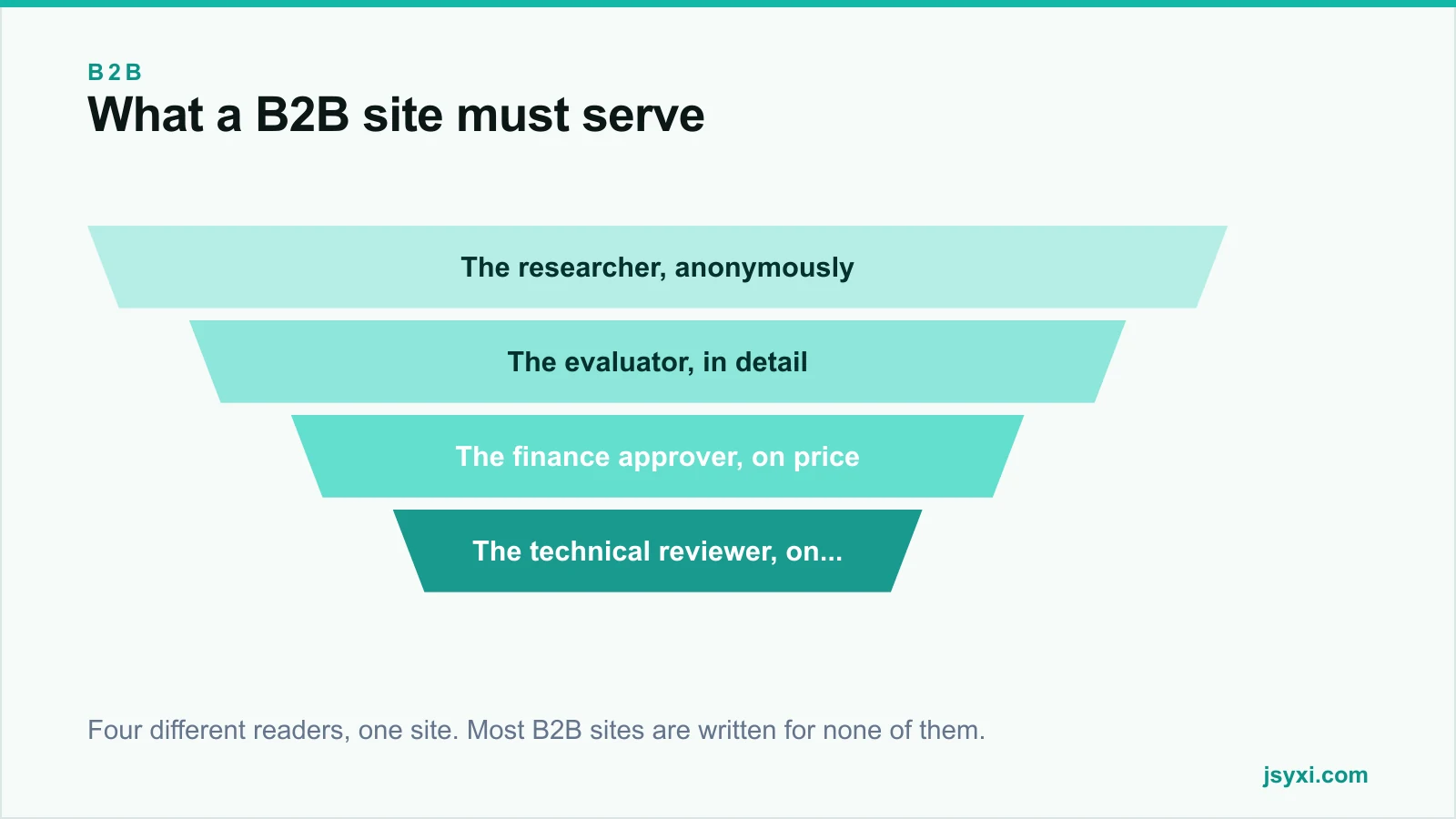
A typical B2B purchase involves several people with different questions:
- The researcher - scoping options, anonymously, early. Wants to understand the category and shortlist quickly.
- The evaluator - comparing shortlisted vendors in detail. Wants specifics, integrations, and proof.
- The finance approver - wants price, terms, and total cost.
- The technical reviewer - wants architecture, security, and compatibility.
Each needs different content. A homepage written only for the researcher leaves the other three unable to do their part, which stalls the deal inside the buyer's organisation.
Publish enough to be shortlisted
B2B buyers eliminate vendors before contacting anyone. To survive that stage you must publish:
- What you do, specifically. Not "digital transformation partner" - the actual services, deliverables, and scope.
- Who you serve. Industry, company size, geography. Being specific attracts better fits and repels poor ones.
- Pricing information. At minimum a starting point, a typical range, or the model. "Contact us" removes you from many shortlists automatically. A price calculator can give an honest estimate without a rigid price list - see our calculator guide.
- Proof. Named clients where permitted, case studies with real numbers, and specifics rather than adjectives.
- How you work. Process, timelines, and what you need from the client.
- Who you are. Real people with real credentials - a team page does more in B2B than in consumer.
Build pages for each stakeholder
- Service pages that go deep on one offering rather than listing everything
- Case studies with context, constraint, approach, and outcome, written for the evaluator
- A pricing or engagement page for the approver
- Technical documentation - integrations, security posture, data handling - for the reviewer
- A comparison page if you are regularly evaluated against known alternatives, written honestly
Honest comparisons that concede where a competitor is stronger are more persuasive than pages claiming to win on everything.
Make the enquiry match the commitment
B2B forms are usually far too long. The visitor is starting a conversation, not signing a contract:
- Name, work email, company, and what they need
- One qualifier if it genuinely changes routing
- A clear statement of what happens next and when
Then qualify properly in the conversation. See our lead capture best practices and qualification framework.
Offer more than one route: a form, a direct email, a phone number, and a calendar link. Different roles prefer different channels, and a procurement lead will often just call.
Respond like the deal matters
In B2B the cost of a slow response is enormous, because each enquiry represents a long cycle and a large value:
- Assign an owner automatically and immediately
- Reply within the hour during working hours
- Make the first reply specific to what they asked, using the context captured on the form
- Have a plan for enquiries arriving outside hours
See speed to lead.
Support the internal sell
Your buyer has to convince colleagues when you are not in the room. Give them ammunition:
- A downloadable one-page summary of the offering
- Case studies that can be forwarded
- Clear pricing they can put in a budget request
- Answers to the objections their finance and technical colleagues will raise
- Anything that makes their internal argument easier to make
The best B2B content is written for the person defending the decision, not for the person making it.
Measure the right things
B2B cycles break most standard analytics:
- Track qualified enquiries, not form fills
- Track pipeline value by source, not session counts
- Expect long lags between first visit and enquiry - preserve first-touch source through to closure, see website to CRM
- Ask "how did you hear about us" to capture what tracking misses
- Report by cohort, since this quarter's revenue came from last quarter's traffic
Common mistakes to avoid
- Hiding pricing entirely. It removes you from shortlists before you know you existed.
- Vague positioning. "Innovative solutions" describes nothing.
- Twelve-field forms on first contact. Qualify in conversation.
- Case studies without numbers. Unquantified stories are anecdotes.
- No content for the technical or finance reviewer. The deal stalls where you cannot see it.
Frequently asked questions
Should a B2B website show pricing?
Show something - a starting price, a typical range, or the pricing model. Buyers eliminate vendors who publish nothing, often without ever contacting them. A calculator or an honest range preserves flexibility.
How long should a B2B lead form be?
Four or five fields for first contact. Name, work email, company, what they need, and at most one routing qualifier. Longer forms reduce enquiries more than they improve quality.
What content do B2B buyers actually want?
Specifics: what you do, who you serve, what it costs, how you work, and evidence that you have done it before for someone like them. Plus material the buyer can forward to colleagues.
How do I measure B2B website performance?
By qualified enquiries and pipeline value by source, not by sessions or form fills, with first-touch source preserved through to closed revenue. Expect long lags and report by cohort.
Next steps
Read your service pages as a finance approver and as a technical reviewer, and write down every question you cannot answer. Publish those answers, then cut your enquiry form to five fields.
For a site built around this, see our software development and digital marketing and SEO services.