
Ideas for better growth
Custom Software or SaaS: How to Decide
Chris Content · · 4 min read
When an off-the-shelf tool is genuinely enough, when a custom build pays for itself, and how to avoid the expensive middle ground of heavily customised software.
The build-or-buy decision is usually made emotionally: a team is frustrated with a tool and concludes that custom software would fit perfectly. Two years later they own a system that does what they needed in 2026, and nobody is left who understands it.
The decision deserves a sequence, not an instinct.
The rule of thumb
Buy the ordinary. Build what makes you different.
Accounting, payroll, email, helpdesk, and basic CRM are solved problems. Someone else has spent a decade and thousands of customers refining them. Your version will be worse and will cost more.
The thing you do differently from every competitor - the workflow that is your actual advantage - is where a custom build can pay for itself.
Question 1: Can a standard tool do this?
Before scoping anything, evaluate properly:
- List your requirements and mark each as must-have or nice-to-have
- Trial two or three tools with real data and real users
- Check integrations against what you already run
- Check the export path - can you leave?
- Count how many must-haves are genuinely unmet
If a standard tool meets your must-haves and misses only conveniences, buy it.
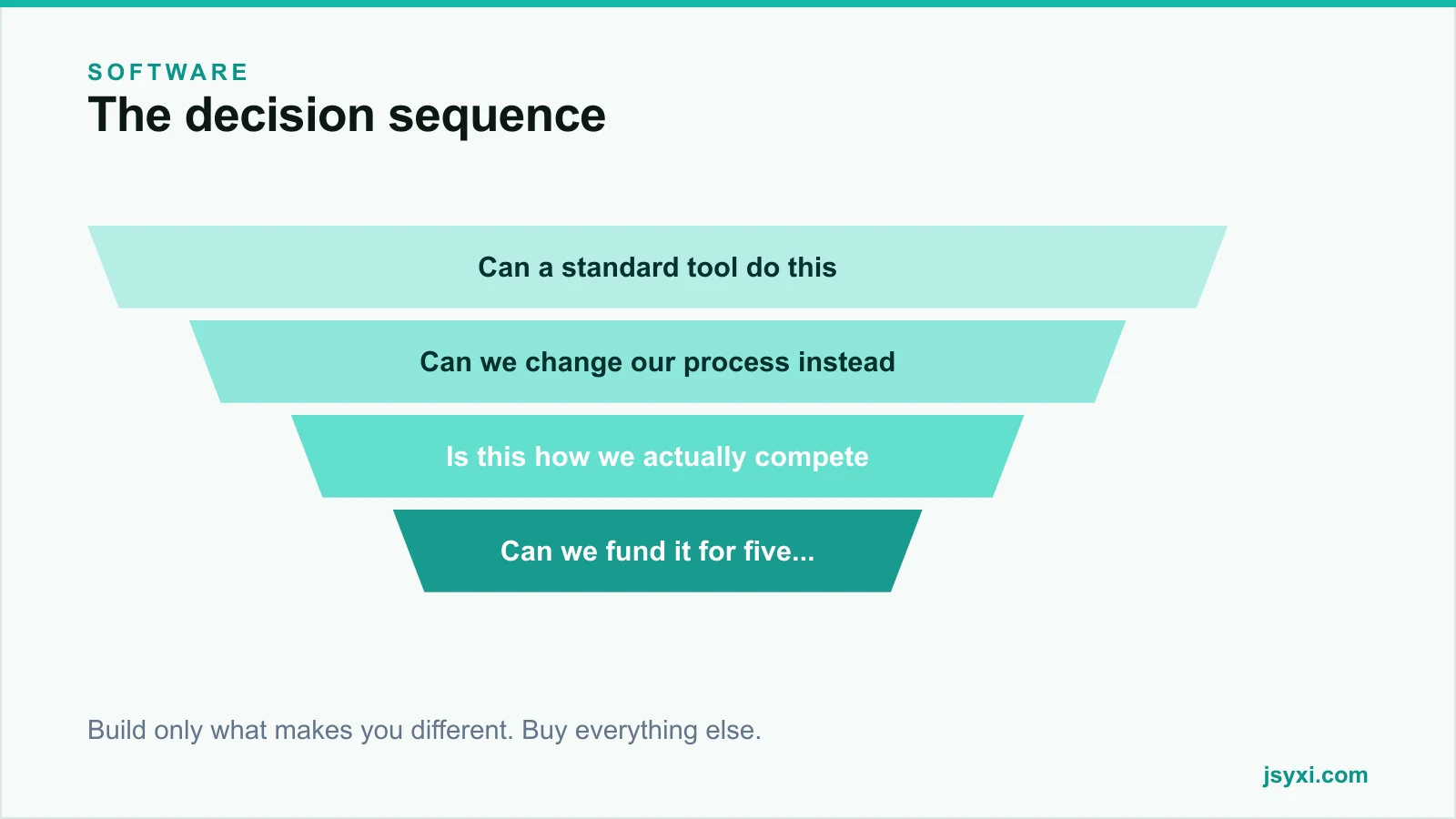
Question 2: Can you change the process instead?
Many "requirements" are habits. Before funding a build, ask whether the process itself is the problem:
- Is this step necessary, or historical?
- Would a standard workflow be acceptable if we retrained?
- Are we recreating a spreadsheet's quirks in software?
- Is one person's preference driving this?
Adopting a standard process is almost always cheaper than encoding a bespoke one. Reserve custom work for processes that genuinely create value.
Question 3: Is this how you actually compete?
Build when:
- The workflow is your differentiator, not an overhead
- Off-the-shelf options force a process that costs you money or customers
- Integration between systems is the bottleneck and no connector exists
- Data volume or specificity exceeds what standard tools handle
- Licence costs at your scale exceed the build and run cost
- You need control over data residency or handling that vendors cannot provide
Question 4: Can you fund it for five years?
The build cost is the smallest part. Budget honestly for:
- Hosting, monitoring, and backups
- Security patching and dependency updates
- Bug fixes and small changes
- Feature work as the business changes
- Documentation and onboarding for new staff
- The risk of the original developer becoming unavailable
A rough planning assumption is that ongoing cost over several years exceeds the initial build. If you cannot fund that, do not start.
Avoid the expensive middle
The worst outcome is a standard product customised so heavily that:
- Upgrades break your customisations
- You are locked to one implementation partner
- You pay licence fees and maintenance costs
- Nobody can say where the product ends and your code begins
If you find yourself planning extensive customisation, step back. Either accept the standard behaviour or build the specific piece separately and integrate it.
The hybrid that usually works
Most small businesses land well here:
- Standard tools for accounting, email, helpdesk, and storage
- A standard commerce platform, extended where necessary
- One custom piece for the workflow that is genuinely yours
- Clean integration between them, with your data exportable throughout
That gives you leverage from other people's product investment and control where it matters. Our custom software development and custom CRM development services are usually scoped exactly this way.
If you build, build defensively
- Start with the smallest version that delivers value
- Own the code and the repository from day one
- Insist on documentation as a deliverable, not an afterthought
- Use boring, well-supported technology
- Plan the data export before the first line of code
- Have more than one person who understands it
Common mistakes to avoid
- Building because a tool annoyed someone. Frustration is not a business case.
- Ignoring run costs. The build is the cheap part.
- Customising a product until it is unrecognisable. You pay twice and can upgrade neither.
- One developer with no documentation. A single point of failure with a notice period.
- Building your differentiator last. Build that first; buy the rest immediately.
Frequently asked questions
When is custom software worth it for a small business?
When the workflow is genuinely how you compete, when standard tools force a process that costs you money, or when integration is the bottleneck and no connector exists. Not because an existing tool is mildly irritating.
How much does custom software cost to maintain?
Plan for meaningful ongoing cost - hosting, security updates, dependency upgrades, bug fixes, and changes as the business evolves. Over several years this typically exceeds the original build cost.
Is it cheaper to customise an existing product?
Sometimes, but heavy customisation is the most expensive option long term: you pay licence fees, maintain custom code, and often cannot upgrade. Prefer light configuration, or a separate integrated component.
What should I build first if I do build?
The smallest piece that delivers real value and that is genuinely specific to your business. Buy everything ordinary around it, and make sure your data can be exported from day one.
Next steps
List your systems and mark each as ordinary or differentiating. Buy the ordinary ones this quarter, and scope a small first version of the one that is genuinely yours.
If you want that scoped honestly, our software development service starts by trying to talk you out of building what you can buy.