
Ideas for better growth
How to Choose a Shopify Development Agency
Chris Content · · 5 min read
What to ask before hiring, how to read a proposal, which red flags matter, and how to structure the engagement so you keep control of your own store.
Choosing a development partner is mostly a risk decision. The upside between a good agency and an excellent one is real but modest; the downside between a good one and a bad one is a store you cannot maintain, a theme nobody can edit, and a year of lost time.
This guide covers how to reduce that risk before you sign.
Step 1: Write down what you actually need
Most bad engagements start with a vague brief. Before contacting anyone, write:
- The business outcome you want, in one sentence
- The specific problems with the current store, with examples
- What must not change - integrations, workflows, existing URLs
- Your realistic budget band and timeline
- Who on your side will make decisions and be available
An agency cannot quote sensibly against "we want a better website". It can quote against "our mobile conversion is weak, our product pages do not answer sizing questions, and our theme takes four seconds to load on a phone".
Step 2: Judge the portfolio properly
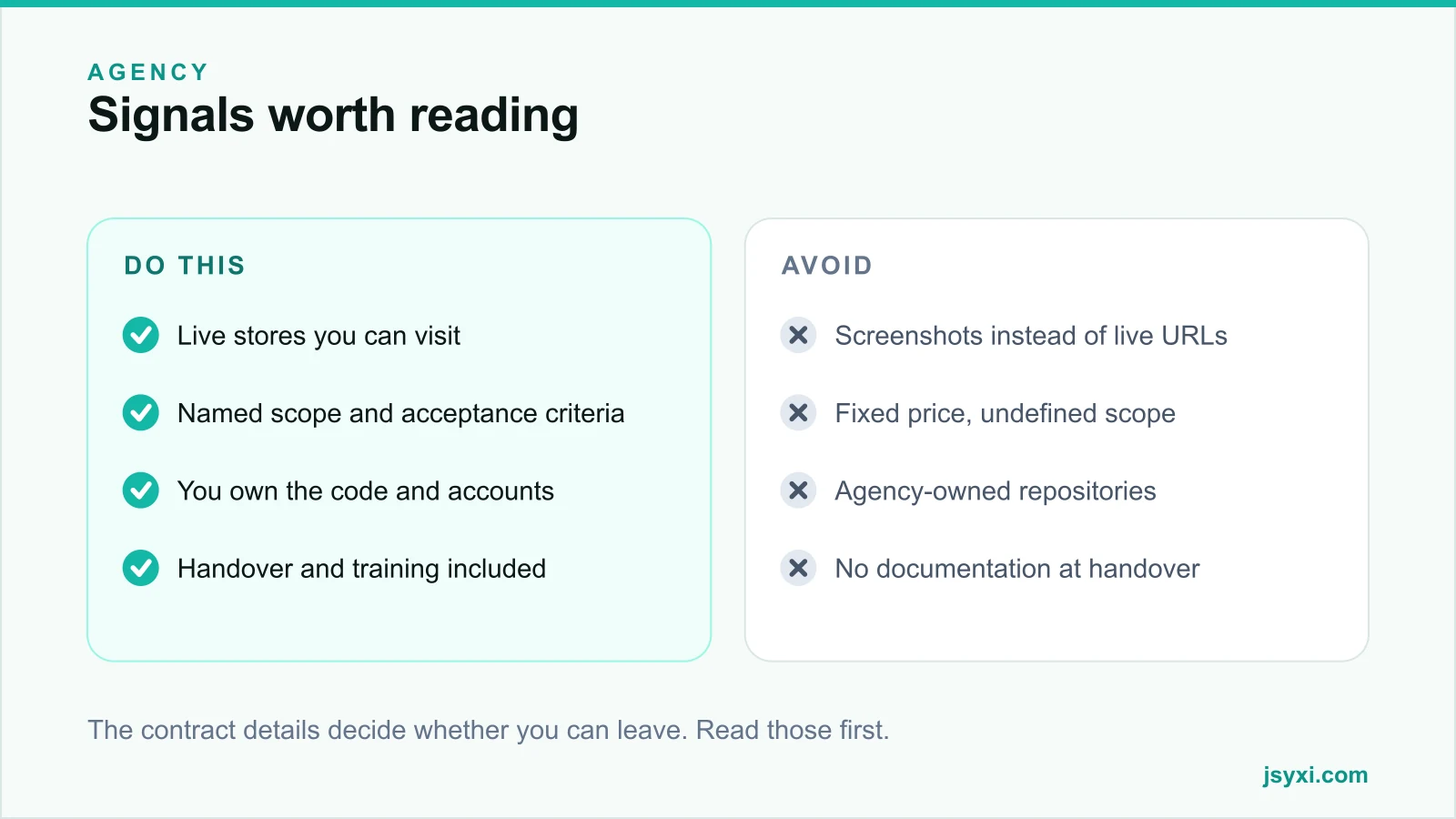
Screenshots prove nothing. Ask for live URLs and then:
- Open each on a mid-range phone and time it
- Complete a purchase journey to the payment step
- Check whether the store is still live and still using their work
- Look for stores in a comparable category and scale
- Ask which parts of that store they actually built
A portfolio of beautiful, slow stores tells you where the agency's priorities sit.
Step 3: Ask the questions that reveal how they work
- How do you handle work outside the agreed scope?
- What does your handover include - code, documentation, training, credentials?
- Who owns the repository and the accounts?
- What is your approach to theme updates and app dependencies?
- How do you test on real devices?
- What happens if performance regresses after launch?
- Who is actually doing the work, and will that change mid-project?
- How do you measure whether the project succeeded?
The last one separates agencies who ship deliverables from agencies who care about outcomes.
Step 4: Read the proposal for scope, not for price
A proposal is a risk document. Look for:
- Deliverables named specifically, not "conversion optimisation"
- Acceptance criteria - how you will both agree it is done
- Assumptions stated, so you know what would change the price
- A change process with rates
- Milestones with payments tied to delivered work
- Post-launch support terms and what is included
A fixed price against an undefined scope is not protection. It is a guarantee of an argument later.
Step 5: Protect your ownership
This is where engagements go wrong long after they end:
- You own the code. Get it in writing, and get access to the repository from day one.
- You own the accounts. Store admin, domain, analytics, payment gateway, and any third-party services must be in your name, with the agency added as a user.
- You get the documentation. How things work, what was customised, what depends on what.
- You get a handover session, recorded, with your team present.
Never let an agency register your domain or hold your production credentials as the sole owner. It is the most common cause of expensive, avoidable disputes.
Step 6: Watch for the real red flags
- Guaranteed rankings or guaranteed conversion percentages
- A price quoted before any discussion of scope
- No questions asked about your business
- Pressure to sign this week
- Portfolio stores that are no longer live
- Reluctance to name the people doing the work
- Unwillingness to give you repository access
- Custom code where a standard feature exists
Step 7: Start small
A small paid discovery or a single well-defined piece of work tells you more than any reference call:
- How they communicate under a deadline
- Whether estimates hold
- Code quality, if you have someone who can review it
- Whether they push back sensibly on bad ideas
If the first small project goes well, expand. If it does not, you have lost weeks rather than a quarter.
Step 8: Define what happens after launch
Most of a store's life is after launch. Agree in advance:
- Who fixes bugs found in the first thirty days, and at what cost
- Response times for a broken checkout versus a cosmetic issue
- Whether ongoing support is retained or ad hoc
- How theme and app updates are handled
- What documentation gets updated when changes are made
Our Shopify development service covers the full build-and-support cycle, and our post on Shopify conversion without a redesign covers what you can improve before commissioning one.
Frequently asked questions
How much should a Shopify project cost?
It depends entirely on scope, from a small theme customisation to a full custom build with integrations. Judge value by defined deliverables and acceptance criteria rather than by the headline number; an undefined fixed price usually costs more in the end.
Should I hire a freelancer or an agency?
A freelancer can be excellent value for well-defined work. An agency is worth the premium when you need several skills, continuity if someone is unavailable, and accountability across a longer engagement.
Who should own the Shopify store and domain?
You, always. Register the domain and the store in your business name and add the agency as a user. Never accept an arrangement where your production accounts are owned by the agency.
What should be included in a handover?
Repository access, documentation of what was customised and why, admin credentials in your name, a recorded walkthrough with your team, and a list of any third-party dependencies with their renewal dates.
Next steps
Write a one-page brief describing the outcome and the constraints, ask three agencies for live URLs rather than screenshots, and start with one small, well-defined piece of work.
If you want to talk through scope first, our Shopify development service starts with a discovery conversation rather than a quote.